
Cavity wall insulation: is your home suitable?

Adam Wilson
In brief
Most homes built from the late 1930s onwards have cavity walls - two layers of brick or block with an air gap between them. Cavity wall insulation fills that gap to reduce heat loss, which can account for up to 35% of a home's total heat loss. It typically costs around £2,000-£3,000 depending on property type, making it one of the most cost-effective fabric improvements available - but only in the right home. The wrong property can turn a straightforward improvement into an expensive damp problem.
What cavity wall insulation does
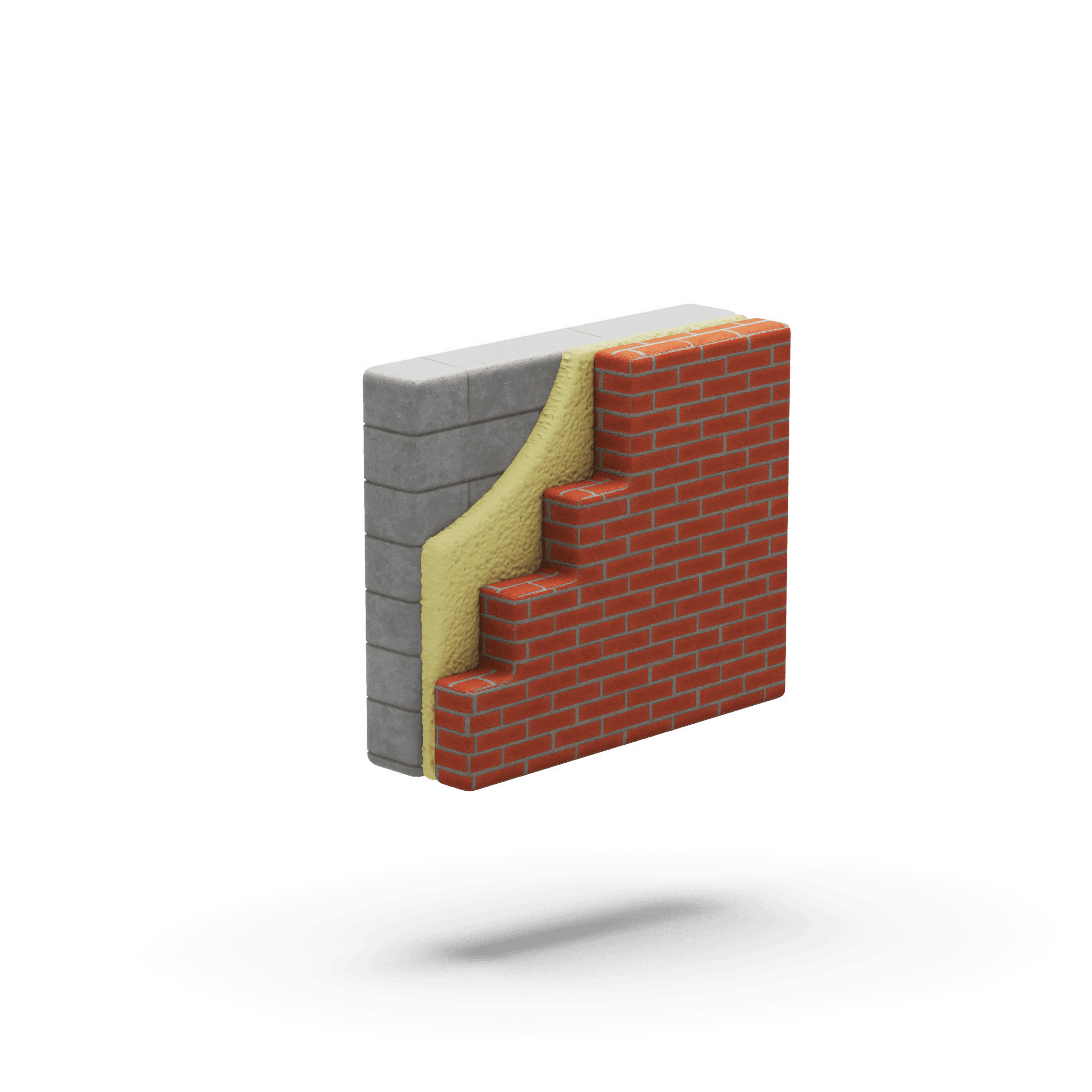
Cavity wall insulation involves injecting insulation material into the gap between the two layers of a cavity wall - no major structural work required. The material is injected through small holes drilled into the mortar between the bricks on the outside of the house, filling the cavity to reduce heat loss through the walls. A typical semi-detached house can be done in a few hours.
In a suitable property, filling an empty cavity makes a significant difference to warmth and energy bills. Annual bill savings range from around £110 to £480 depending on property type, with a typical payback period of 7-14 years. It is one of the lower-cost fabric improvements available - but only when the home and cavity are genuinely suitable.
Does your home have a cavity wall?
Before any discussion of materials or costs, the first question is whether your home has cavity walls at all. Cavity walls became common in UK housebuilding from around the 1930s onwards, though some earlier examples exist. Homes built before this period almost always have solid walls and are not candidates for cavity fill - they would need internal or external wall insulation instead.
Post-1995 homes were typically built with insulation already installed in the cavity. The main target for retrofit cavity wall insulation is properties built between the 1930s and mid-1990s, where the cavity exists but was left unfilled.
The simplest visual check is the brickwork pattern on the external face. Cavity walls typically show only the long face of bricks in a regular, uniform pattern. Solid walls often show a mix of long and short brick faces, though this is not always definitive. Wall thickness is another indicator - measure the depth of a window or door reveal. A total wall thickness of around 260-270mm or more suggests a cavity; thinner walls are more likely solid.
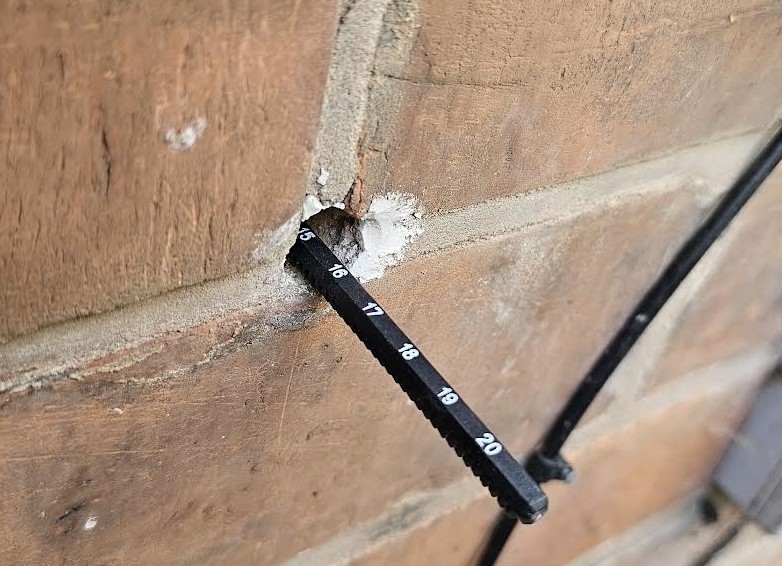
If there is any doubt, a borescope inspection (a small camera inserted through a drilled hole) during a professional survey will confirm whether a cavity is present, how wide it is, and what condition it is in. Getting this wrong is one of the most common and costly mistakes in home retrofit - it is worth confirming before making any insulation decision.
If your home was built before the 1920s, it almost certainly has solid walls rather than cavity walls. Some late-Victorian or Edwardian properties do have early, narrow cavities, but these were not designed to be filled - they require specialist assessment before any insulation decision.
When cavity wall insulation is - and isn't - the right choice
Cavity wall insulation is a high-value measure in the right home, but a high-risk one in the wrong home. The consequences of getting it wrong - damp, mould, structural staining, expensive remediation - can far outweigh the savings. A proper suitability assessment is not a formality; it is the most important part of the entire process.
Homes likely to be suitable
Post-1930s properties with a clean, continuous cavity of 50mm or more, in a location that is not heavily exposed to wind and driving rain, with sound external brickwork, intact mortar, and no history of damp are generally good candidates. The cavity should be free of significant blockages, and the damp-proof course (the moisture barrier near ground level) should be clearly exposed at least 150mm above ground level all the way around the property.
Homes where caution or specialist advice is needed
Narrow or marginal cavities. Anything less than 50mm of clear cavity is problematic. Some EPS (expanded polystyrene bead) products can work down to 40mm, but this is the absolute minimum. Any protrusions - brick headers, mortar droppings, debris - reduce the effective width further.
Exposed locations. Properties in the UK are rated by exposure zone - a standard classification based on location, topography, and local wind patterns. In sheltered or moderate zones, both mineral wool and EPS can be used. In severe or very severe zones - coastal areas, elevated or exposed sites - EPS beads are essential because they allow moisture to pass through rather than absorbing it. Mineral wool should not be used in high-exposure areas.
Poor external brickwork or pointing. If there are obvious cracks or gaps in the mortar, or the brickwork is spalling (crumbling or flaking on the surface), these must be rectified before any insulation is installed. Poor pointing is one of the most common reasons cavity wall insulation fails - it allows moisture into the cavity, where it damages the insulation over time.
Breached damp-proof course. The damp-proof course must be exposed at least 150mm (roughly two brick courses) above ground level. Over time, homeowners build up ground levels with driveways, patios, and shrub beds without realising they are breaching the damp-proof course. When ground level rises too close, driving rain bounces off the ground into the cavity, and any insulation installed below or across the damp-proof course creates a direct path for moisture into the property.
Existing damp or moisture problems. Any visible damp - internal or external - needs to be resolved before cavity wall insulation is considered. Filling a cavity in a home that already has moisture issues will make the problem worse, not better.
Compromised wall ties. Wall ties are the metal or composite connections between the inner and outer leaves of the wall. If they are corroded, covered in mortar buildup, or angled the wrong way (directing water inward rather than outward), they can create moisture bridges into the property. A borescope inspection should check wall tie condition as part of any pre-installation survey.
CWI at Furbnow
Recommended for: ~25% of the homes Furbnow has assessed
Most common in: homes built between the 1930s and mid-1990s with unfilled cavities
Average cost: ~£2,000-£3,000
Typical annual savings: ~£110-£480 on energy bills, ~570kg of CO₂
The biggest benefit: rooms that hold their heat and stay comfortable all year round
Costs and savings vary depending on property type and size, cavity condition, and insulation material.
How cavity wall insulation is installed - and what a good survey looks like
The installation process
Cavity wall insulation is a same-day, minimally disruptive process - typically completed in two to four hours with no internal disruption and the property occupied throughout.
1. Pre-installation survey. Checks cavity width, wall construction, how exposed the property is to wind and rain, existing insulation, damp, wall tie condition, damp-proof course, and the condition of the mortar and brickwork. A borescope inspection is standard.
2. Drill holes. Small holes (around 22-25mm) are drilled into the mortar between the external bricks in a staggered pattern, typically every 1-1.2 metres. Installers will always drill under windows - if cavity wall insulation has been installed previously and there are no drill patterns under the windows, it is likely the fill is incomplete.
3. Inject insulation. The material is blown or injected through the drill holes until the cavity is uniformly filled.
4. Reinstate holes. Drill holes are filled with matching mortar to get as close a colour match as possible.
5. Post-installation check. Fill is confirmed via thermal imaging or a post-installation borescope survey. The installation is registered with CIGA (the industry guarantee body) and a 25-year guarantee certificate is issued.
What a good survey should include
What matters far more than the installation day is the quality of the inspection work that precedes it. There is an important distinction between a basic borescope inspection and a thorough cavity wall survey - and the thorough version is not just something that happens immediately before an install. It is how you decide whether cavity wall insulation should be done at all.
"A basic borescope inspection is just confirming there's a cavity there, maybe the width," explains Jamie Taylor, Projects & Compliance Manager at Furbnow. "A proper cavity wall survey is a lot more in-depth - checking multiple parts of the wall, the condition of wall ties, any mortar buildup, any rubble, any penetrations in the mortar."
A thorough cavity wall survey should include two to three inspection points on each elevation of the property, at different heights - not just one drill hole at ground level. Insulation that has slumped or settled tends to show problems higher up the wall first. The survey should also check cavity width and continuity, damp-proof course condition and clearance, wall tie condition, the state of the mortar between bricks, and any evidence of existing moisture or cavity bridging (obstructions that create a path for moisture across the cavity).
For homes with existing cavity wall insulation - particularly those installed under older government schemes - a single inspection point is not enough. Just because insulation is present at one point on a wall does not mean it is continuous two metres to the left or right. Some installers have historically cut corners: filling the ground floor but leaving the first floor empty, or starting at the back of the property and running out of material before finishing the front.
Choosing the right fill material
The right material depends on the specific cavity and exposure conditions - not on installer preference or cost alone. There are three main types of retrofitted cavity wall insulation.
EPS beads (expanded polystyrene). Small polystyrene beads blown into the cavity with an adhesive that causes them to bond together and become rigid over time. EPS is moisture-resistant - driving rain that enters the cavity can still pass down through the insulation to the damp-proof course and escape, rather than being absorbed. This makes it particularly suitable for properties in higher-exposure areas. Most installers now default to EPS. It is marginally more expensive than mineral wool - roughly two to three pounds per square metre more - but the reduced risk is generally considered worth it.
Mineral wool. Blown mineral wool was the most commonly retrofitted cavity insulation until fairly recently. It is non-combustible, well-established, and cost-effective. The main risk is that mineral wool absorbs moisture. If it is installed in a property that is not ready to take it - gaps in the mortar, damp-proof course problems, high exposure to driving rain - the insulation absorbs water over time, becomes heavy, and slumps within the cavity, leaving voids. The insulation itself is not usually the problem; it is the building condition that causes the failure.
Urea formaldehyde foam. A foam insulation that was widely used historically. When installed well, it performs effectively. The problem is that many installations were not done well, and the foam degrades over time, becoming brittle, discoloured, and crumbling. Extraction is significantly more expensive than other materials and carries additional health and safety considerations because the material can emit formaldehyde gas during removal. Polyurethane foam is a different product but shares similar removal challenges and is not used by Furbnow.
The choice of material should always be driven by the survey findings. A good retrofit designer or coordinator will specify the appropriate material for the specific home based on cavity width, how exposed the property is, and existing condition.
Costs and savings
Cavity wall insulation is one of the lower-cost fabric improvements available. Costs vary by property type but typically average around £2,000-£3,000. Installation usually takes half a day.
Annual energy bill savings usually range from £110-£180 for terraced homes, £180-£285 for semi-detached, and £300-£480 for detached properties. The typical payback period is 7-14 years, depending on property type and size.
For homeowners considering post-installation verification, a thermal imaging survey by an independent thermography consultant costs around £500. Whether this is worthwhile depends on the project. "If there are hard-to-reach areas or a lot of services running through the walls, it probably warrants the thermal imaging," says Jamie Taylor. "A nice detached house with limited penetrations and good brickwork is probably low risk."
Funding
Government schemes exist to help with the cost of cavity wall insulation:
Warm Homes: Local Grant - now the main route for cavity wall insulation funding. Administered by local councils in England, it provides grants of up to £15,000 for energy efficiency measures including cavity wall insulation.
ECO4 (Energy Company Obligation) - extended to the end of December 2026, but winding down. Can fund cavity wall insulation for eligible households, typically those on qualifying benefits or with lower energy efficiency ratings.
Great British Insulation Scheme (GBIS) - ended in March 2026.
For homeowners not eligible for grants, the relatively low cost of cavity wall insulation means it is often worth funding privately - particularly when it is part of a wider renovation project where scaffolding or external access is already in place.
The real risks: damp, failed installations, and what to do if things go wrong
Damp is the most commonly reported problem following cavity wall insulation - but in almost every case, the insulation itself is not the cause.
Nine times out of ten, the insulation is not the thing that has failed. It has been put into a house that was not ready to take it - there might have been gaps in the mortar, or issues at eaves level or with the damp-proof course. As soon as moisture gets into a cavity with mineral wool in particular, it absorbs all that moisture, slumps, and you end up with massive voids.
Warning signs to look for
If you suspect your existing cavity wall insulation may have failed, look for:
New damp patches appearing on internal walls
Mould growth, particularly around window reveals
Brickwork crumbling or flaking on the external face
The property feeling noticeably colder than expected
EPS beads visible in the loft space or air bricks (a sign the fill was not properly contained)
A professional borescope inspection can reveal problems that are not visible from inside or outside the property - mineral wool that has absorbed water and slumped, EPS beads that have not bonded properly, or foam insulation that has become brittle and started to crumble. If you are buying a property with existing cavity wall insulation, a thermal imaging survey and cavity inspection are worth considering before assuming the insulation is performing correctly.
Guarantees
Cavity wall insulation installations should come with a 25-year CIGA (Cavity Insulation Guarantee Agency) guarantee, provided free to the homeowner by a CIGA-registered installer. It covers material performance, installation defects, and damp caused by the installation, and is transferable if the property is sold. However, CIGA does not cover pre-existing damp or structural issues - and if unsuitable conditions were ignored at the time of installation, claims can be contested. Separate to the CIGA guarantee, installers typically offer a one-to-five-year workmanship warranty covering the reinstatement of drill holes and similar items.
A guarantee is not a substitute for getting the installation right in the first place. Always obtain and file the CIGA certificate, the installer completion certificate, the pre-survey or borescope report, the product certification certificate, and an updated EPC (Energy Performance Certificate).
Cavity wall insulation in the context of a whole-home upgrade
Cavity wall insulation works best when it is planned alongside other fabric improvements, not treated as an isolated decision. Reducing heat loss through walls changes the thermal dynamics of the whole house, which affects heating system sizing, ventilation requirements, and the performance of other measures. Read more about whole-house retrofit here.
Sequencing matters
One of the most common sequencing questions is whether to replace windows or install cavity wall insulation first. The answer is windows first. If cavity wall insulation is installed and then windows are replaced later, removing the old windows can disturb or damage the insulation - particularly where the window frame sits within the cavity. It can also give the guarantee provider grounds to contest a claim if problems emerge later. The same principle applies to extensions or any structural work that involves opening up external walls - get the structural changes done before filling the cavity.
If external rendering or repointing (replacing the mortar between bricks) is planned, coordinate it with the insulation decision. External wall insulation may be more appropriate in some cases, particularly where the external face already needs significant repair or where the cavity is unsuitable for fill.
Ventilation
Improving the airtightness of a home through insulation without addressing ventilation can lead to condensation and air quality problems. Any insulation upgrade should include a review of the ventilation strategy: mechanical extractor fans in wet rooms (kitchens, bathrooms, utilities), trickle vents in windows for background ventilation, and adequate door undercuts to allow air to circulate between rooms. Without adequate ventilation, a better-insulated home can develop condensation on windows and mould in corners - the opposite of what the upgrade was meant to achieve. Read more about ventilation here.
Cavity wall insulation alone will not transform a cold, draughty home. But as part of a coordinated plan that includes loft insulation, draught-proofing, heating system upgrades, and ventilation improvements, it contributes meaningfully to a warmer, more comfortable house.
The right starting point
The difference between a cavity wall insulation project that works and one that causes problems comes down to what happens before installation - the survey and the sequencing. Installers will carry out their own due diligence before filling a cavity, but their focus is on the installation itself. What they are less likely to do is consider whether cavity wall insulation is the right measure for your home in the first place, or how it fits alongside everything else the property needs.
An independent, whole-house assessment considers not just whether the cavity can be filled, but whether it should be - and how it fits alongside every other improvement the home needs.
Book a free call to talk through your situation and find out how Furbnow can help.
0330 165 6147
AWARDS & RECOGNITION