Internal wall insulation: the complete guide

Adam Wilson
In brief
Internal wall insulation (IWI) reduces heat loss by adding insulation to the inside face of external walls. It is the main option for solid wall properties - typically homes built before the 1930s - where external insulation is not feasible. A well-designed system can cut heat loss through the walls dramatically, making a noticeable difference to warmth and comfort. But the risks are serious if the work is poorly designed: trapped moisture, damp, and structural damage. Getting IWI right means understanding your wall construction, managing moisture, and upgrading ventilation as part of a whole-house plan.
What is internal wall insulation?
Internal wall insulation is the application of an insulating layer to the inner face of a property's external walls. It reduces heat loss through the building fabric, improves thermal comfort, and lowers energy bills. For many homeowners, the most immediate difference is how much warmer the rooms feel.
It is primarily used in properties with solid brick or stone walls, where there is no cavity to fill. Most UK homes built before the 1930s have solid walls. But IWI is also used where external wall insulation is not feasible due to restricted external access, conservation area restrictions, listed building constraints, or narrow shared spaces between properties.
Solid walls can account for around 35% of a home's total heat loss. To put that in perspective, a typical uninsulated solid wall lets through roughly ten times more heat than a well-insulated one. The technical measure for this is the U-value - a number that shows how much heat passes through a material, where lower is better.
Raychelle Lemi, Chartered Architectural Technologist at Furbnow, explains the scale of improvement that is possible: "A well specified system can take a solid wall U-value from 2 to 0.3, which is quite significant thermal improvements. That's where a lot of systems that we have proposed are quite valuable in the retrofit process."
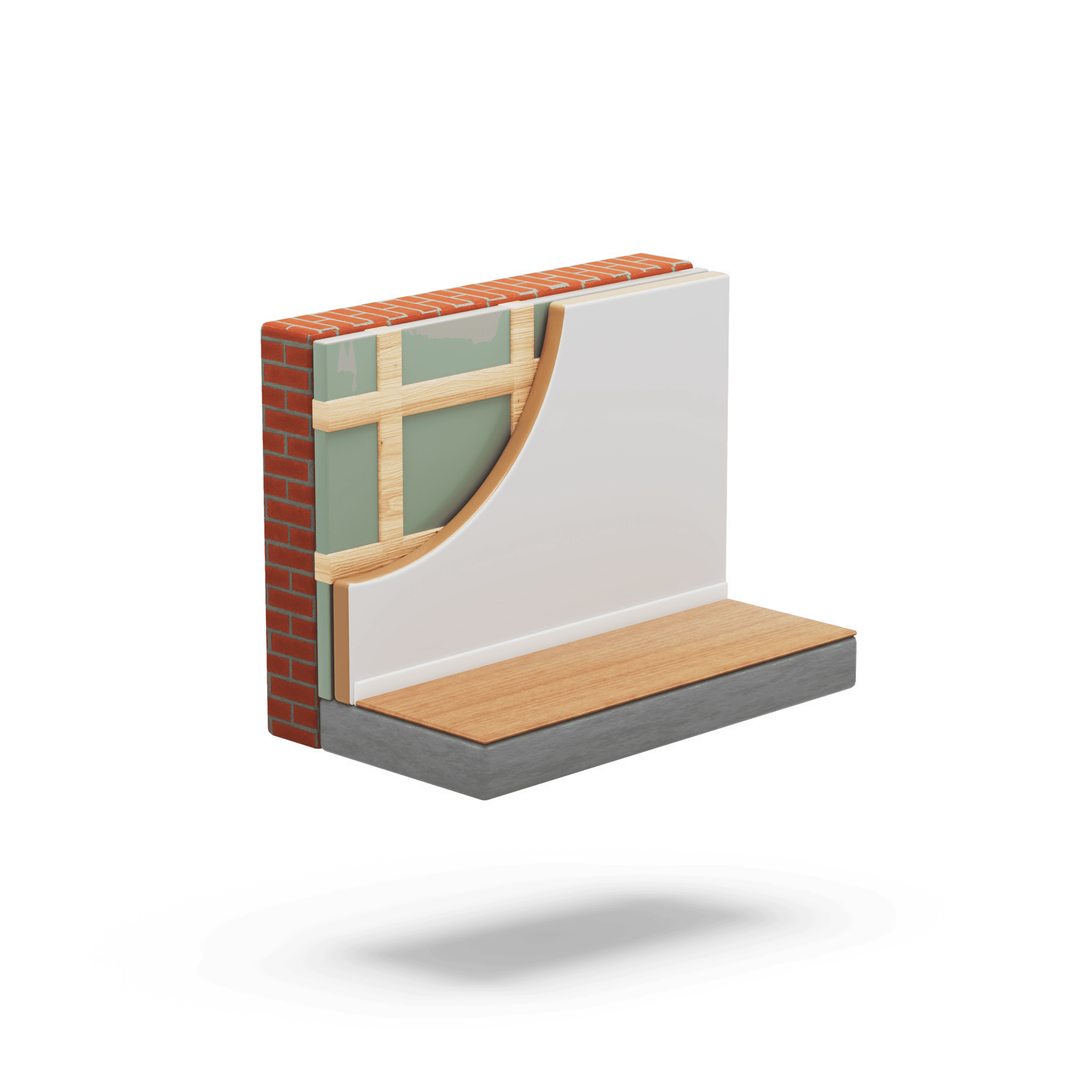
IWI is a significant structural upgrade. It involves stripping back existing plaster, assessing the underlying brickwork or blockwork, installing insulation boards or systems, and then re-plastering and redecorating. It is not to be confused with decorative interior wall panels, which offer negligible thermal improvement.
Is internal wall insulation worth it for your home?
If your home has uninsulated solid walls and you want it to be meaningfully warmer, IWI is one of the most impactful upgrades available. But whether it is the right choice depends on your property, your budget, and what else you are planning to do.
Identifying solid walls
Not all older homes have solid walls. Cavity walls became common from the 1940s and 1950s onwards, though cavity wall insulation only became mandatory around the mid-1990s. If your home was built before the 1930s, it almost certainly has solid walls. For properties built between the 1930s and 1990s, a visual check of the external brickwork can help: if the bricks show a regular stretcher bond pattern (all bricks laid lengthways), it is likely a cavity wall. If you can see a mix of headers (short end visible) and stretchers, it is likely solid.
Wall thickness alone is not always a reliable indicator of heat loss. Some older properties have 600mm of solid masonry, which can have a similar U-value to a standard uninsulated cavity. But without insulation, the wall is still losing heat.
The trade-offs
IWI will slightly reduce the internal footprint of the rooms being insulated. Depending on the material and the target performance, you are typically looking at around 100mm of depth added to each external wall, though stripping existing plasterboard can claw back some of that space.
There is a middle ground between the two. Most homeowners find the finished result looks better than they expected, and the slight loss of room depth becomes unnoticeable within a few weeks. What is noticeable is the difference in warmth - rooms that previously needed constant heating hold their temperature far more effectively.
For homeowners already planning a renovation - stripping back kitchens or bathrooms, or re-plastering - IWI is particularly cost-effective to install at the same time. Another advantage over external wall insulation: IWI can be done in phases, room by room, which helps with budgeting.
There may also be a noticeable improvement in noise reduction. Tom Woodward, Retrofit Project and Technical Coordinator at Furbnow, notes that "making any wall thicker will provide some acoustic benefit - but the primary benefit is thermal comfort."
The whole-house approach: why sequencing matters
Insulating walls from the inside makes the home more airtight, which means the existing ventilation may no longer be adequate. Under building regulations, a whole-dwelling ventilation strategy is required when wall insulation is installed.
IWI should be part of a sequenced plan that considers the property as a whole system, not a standalone measure installed without regard for what else needs to change. Read more about whole-house retrofit here.
When IWI is part of a broader retrofit, sequencing matters. Windows should be changed first, because the window reveals need to be insulated and doing it the other way round damages the freshly plastered walls. Any ventilation coring through walls should happen before the IWI system goes on. And if floor insulation is being done at the same time, lifting the perimeter floorboards allows the wall insulation to extend right down below the floor, avoiding a thermal bridge at that junction.
IWI at Furbnow
Recommended for: ~20% of the homes Furbnow has assessed
Most common in: Edwardian and Victorian terraced homes
Average quote: ~£20,000 (varies by property size, material, and scope of works)
Typical annual savings: ~£500 on energy bills, ~650kg of CO₂
The biggest benefit: rooms that feel warm all day, not just when the heating's on
Costs and savings vary depending on property type, size, wall construction, insulation material, and the extent of associated works.
The hidden risks: managing moisture, condensation, and ventilation
Poorly specified IWI can trap moisture inside the wall, leading to condensation forming within the wall structure itself (known as interstitial condensation), mould, and structural damage over time. This is the most serious risk with internal wall insulation, and it is avoidable with proper design.
Why moisture matters
Adding insulation to the warm side of a wall makes the wall itself colder, changing how moisture moves through it.
In simple terms, moisture gets trapped between the insulation and the wall. If there is a void between the vapour barrier and the wall surface, water vapour hits the cold wall, condenses, and sits on the cold side of the insulation where it can degrade the insulation over time.
Before IWI is installed, a hygrothermal risk assessment is required. This is a detailed analysis that models the full wall build-up - including the existing wall and the proposed insulation system - and simulates how vapour moves through it. This is what determines whether condensation is likely to occur.
Thermal bridging
Thermal bridging is where the insulation is interrupted or thinned, creating cold spots. With IWI, the most common locations are where internal partition walls or floors meet external walls, around window and door reveals, and where services like pipes or sockets penetrate the insulation layer.
Every gap where the insulation meets an internal wall, a ceiling, or a floor needs to be closed off. If it is not, heat and air will escape through it.
The government guidance recommends returning insulation along thermal bridge junctions by a minimum of 400mm where possible, and using thin insulation in window reveals to reduce thermal bridging.
Ventilation is not optional
How the ventilation is upgraded depends on the property. The right approach depends on how airtight the property is after the IWI is installed and how many people live there. As Tom puts it: "The more you're improving the U-value, the more airtight you're making the property, and the more important the ventilation becomes." Options range from continuous extract fans in wet rooms, to intermittent fans with trickle vents, to a centralised system with ducting and heat recovery. Read more about ventilation here.
What is the best insulation for internal walls? Materials and methods
There is no single "best" material for IWI. The right choice depends on the wall construction, the moisture profile of the existing wall, the thermal performance target, how much room depth the homeowner is willing to lose, and the budget.
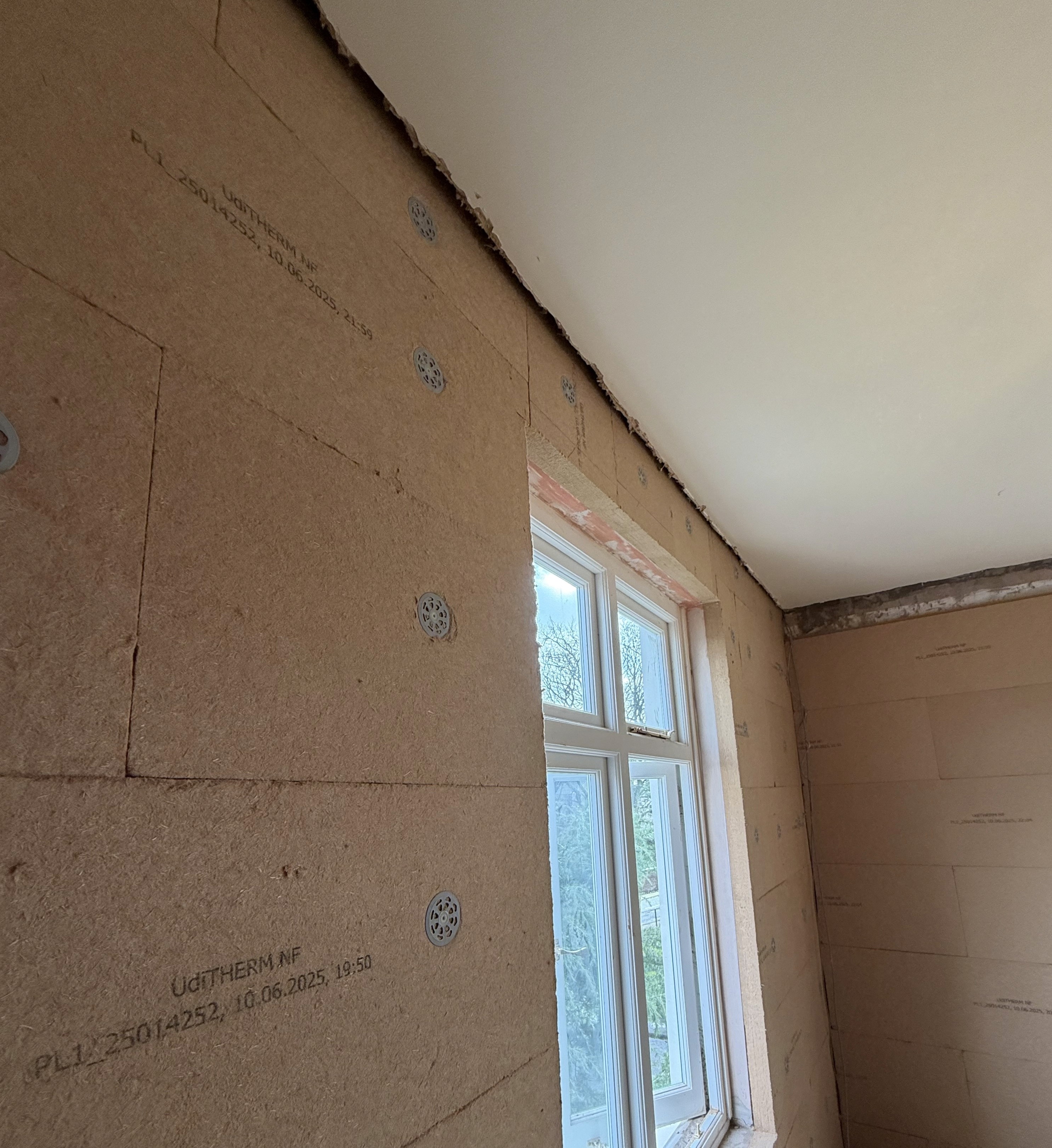
The starting point is always the construction of the property. For solid walls, we favour breathable materials to avoid causing damp problems by introducing a non-breathable layer.
Material | Thermal conductivity | Key advantages | Key limitations |
|---|---|---|---|
Mineral wool slab | 0.032-0.040 W/mK | Non-combustible, good fire performance, acoustic benefit | Thickest profile. Requires careful moisture management |
Wood fibre board | 0.038-0.050 W/mK | Absorbs and releases moisture naturally. Sustainable. Suited to older buildings | Thicker profile, higher cost, limited installer familiarity |
Aerogel blanket | 0.013-0.018 W/mK | Ultra-thin, minimal room loss. Ideal for window surrounds and tight spots | Significant cost premium. Specialist installation |
Insulated plaster | 0.022-0.040 W/mK | Insulation and plasterboard in one layer, so easier to install | On its own, lower thermal performance than other options |
Note: Thermal conductivity (measured in W/mK) indicates how well a material conducts heat. Lower numbers mean better insulating performance.
Raychelle explains how multiple materials can work together on the same IWI project: "The overall build-up used everywhere could be a wood fibre board. But then when you get to a window jam, for example, you can use an aerogel system. It's quite useful for projects where the window frames are quite thin and the customers don't want to replace the windows."
Upgrading older, traditional, and listed properties
Traditional buildings, particularly those built before the 1930s, were designed to manage moisture by allowing it to pass through the walls. This "breathability" is central to how they stay dry. Installing the wrong type of insulation can fundamentally disrupt this, trapping moisture and causing damage that may not become visible for years.
Vapour-open (breathable) materials like wood fibre are crucial when insulating solid walls. If the original wall was built with lime mortar, any insulation system should maintain that vapour-open consistency. As Tom puts it: "Don't suddenly mix it up by putting on a cement-based product, which could trap the moisture and make it go from a vapour-open to a vapour-closed system."
For traditional properties, there are also specialist options. Lime-based render systems can be sprayed on and maintain the vapour-open profile of the original construction. Cork-based boards are another breathable option suited to older buildings.
For heritage buildings, the government guidance requires a heritage significance assessment before IWI is installed. For listed buildings, Listed Building Consent is typically required.
Preserving period features
IWI often requires removing existing plaster back to the underlying wall, which means period features like cornices, picture rails, and deep skirting boards must come down. If the coving needs to be kept, it has to be removed and either replaced with off-the-shelf alternatives or remade by a specialist to match the original. We work with specialists who provide bespoke coving for exactly this purpose.
If coving is not removed, there will be an awkward detail where the insulation meets the ceiling, and a thermal bridge at the junction. Most homeowners see IWI as an opportunity to freshen up a room, and near matches for skirting boards and architraves can usually be found.
"Anyone can stick on an insulation board, but are they going to think about the science behind it?"
Tom Woodward, Retrofit Project and Technical Coordinator, Furbnow
The installation process: disruption and detailing
IWI is disruptive, and there is no way around that, but the disruption can be managed with clear planning and communication.
Before installation begins
Assess the existing wall. The underlying brickwork or blockwork needs to be assessed for damp, structural integrity, and condition before anything else. Any damp sections must be diagnosed, rectified, and allowed to dry thoroughly before IWI is installed. External defects - cracked render, failing pointing, blocked gutters, damaged flashings - should be repaired first to stop water getting into the wall.
Clear the room. Rooms need to be cleared out. Dust finds a way into everything, so valuables and anything precious should be removed from the working area. Carpets will need to come up at floor junctions, and furniture needs to be moved out or into rooms not being worked on.
Plan for storage and access. Insulation materials need covered storage, whether that is a garage, a spare room, or a well-protected external area. Skip access is needed for removing old plaster, skirting boards, and offcuts.
During installation
If the system requires it, existing plaster is stripped back to the wall behind it. This is the most disruptive phase, especially in older properties with lath-and-plaster walls (thin wooden strips with plaster applied over them, common in pre-war properties), which are extremely dusty. The exposed wall is then assessed for defects such as structural cracks or damp.
If the brickwork is uneven, a thin levelling coat of plaster is applied to smooth the surface and create an airtight seal. The insulation is then fixed to the wall using adhesive, mechanical fixings, or both, depending on the system.
At floor junctions, the insulation needs to extend down into the floor space. Where timber joists are embedded in the wall, care is needed to protect the joist ends with an airtight seal and to ensure insulation is tight against the joists to avoid creating cold spots. Timber joists with a moisture content greater than 20% should not have IWI installed around them until the source of moisture is identified and the joists have dried out.
The finish is either a skimmed surface directly onto the insulation board, or a plasterboard layer over the insulation, depending on the system. Then everything goes back together: skirting boards, architraves, electrics, plumbing, and decoration. Where a lime plaster finish is used, this presents a different textured finish to typical gypsum plaster and can often feel rough to touch in comparison. Homeowners should ask to see, and even feel, a sample section prior to agreeing to the finish to ensure that expectations are managed throughout the process. Different finishes of lime plaster can be applied, but they require a different level of skill and time which can affect the project cost.
Timescales
How long IWI takes depends on the system and the room size. An insulated plasterboard system can be completed relatively quickly. A wood fibre system, which requires drying time between layers, can take considerably longer. Raychelle notes that some systems "could take weeks" for a full installation, depending on the scale of the project.
Case Study
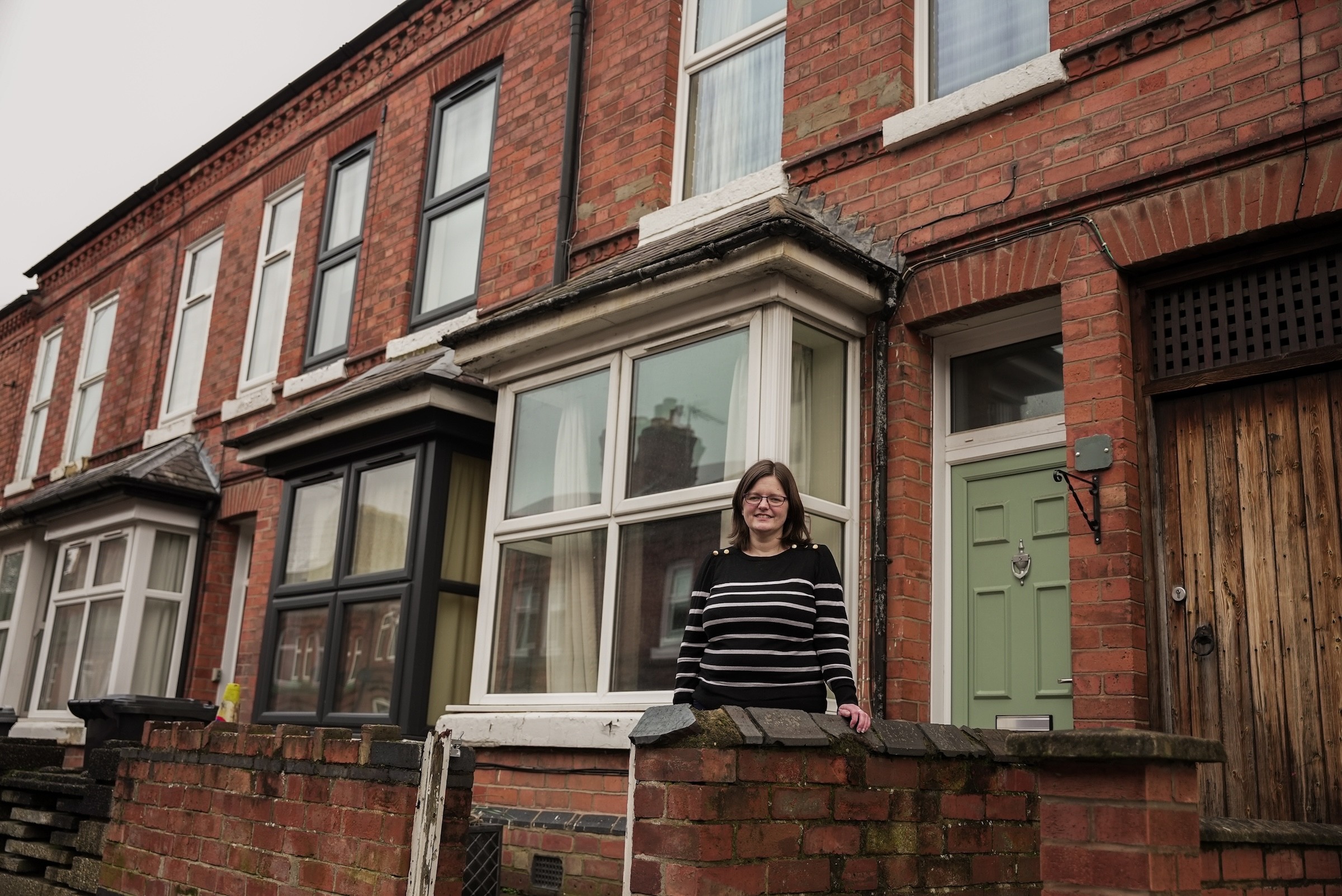
Jennifer had IWI and suspended floor insulation installed in her 1880s terrace in Leicester. The difference was immediate: the house feels noticeably warmer, her EPC improved to C, and her daily gas use dropped by 30%. Read the full case study here.
Internal wall insulation costs in the UK
Wall insulation costs around £200 per square metre for most standard systems, including labour and materials. For a full detached property, internal wall insulation typically costs £20,000 or more, though this varies significantly depending on the complexity and size of the property.
The material cost is only part of the picture. With IWI specifically, the real cost drivers in older homes include:
Removing and reinstating skirting boards, architraves, and coving
Relocating radiators, sockets, and light switches
Replastering and redecorating after installation
Addressing damp or structural issues discovered once plaster is stripped
Window reveal insulation and detailing around openings
Tom cautions against relying on simple per-square-metre cost comparisons: “It very much depends on the material, the system, how it’s applied, the thickness, what preparation is needed, fixtures and fittings to remove, how many windows on that wall, the window reveals. A simple per-square-metre calculation is misleading.”
The payback period for solid wall insulation, whether internal or external, is long. The main benefits are not financial - the real case for solid wall insulation is that cold walls become comfortable and the home holds its heat instead of losing it through the fabric.
One advantage specific to IWI is that it can be phased room by room, spreading the cost over time. If the budget does not stretch to the whole house at once, doing it room by room over a period of months or years is a practical alternative.
Do you need planning permission for internal wall insulation?
In most cases, no. Standard IWI falls under Permitted Development and does not require planning permission. The main exceptions are listed buildings and some homes in conservation areas, where Listed Building Consent will typically be required.
IWI is, however, notifiable building work under Part L of the Building Regulations (conservation of fuel and power). In practice, if the installer is registered under an approved Competent Person Scheme, they can self-certify the work and issue a compliance certificate directly, meaning the homeowner does not need to submit a separate building notice. If the installer is not scheme-registered, the homeowner must notify their local Building Control body before work begins.
Part L sets the U-value targets (typically 0.3 W/m²K for insulating existing walls, or down to a threshold of 0.7 subject to conditions set out in the Approved Document), while Parts F, B, and C cover ventilation, fire safety, and moisture resistance respectively.
How to choose the right installer and guarantee quality
The physical installation of IWI is not complicated. What matters is the knowledge behind it. As Tom explains: “A general builder might not recognise or be prompted to think about ventilation. Anyone can stick on an insulation board, but are they going to think about the science behind it?”
IWI products are part of wider systems, not standalone materials. As Tom puts it: “It’s not just a product slapped on the wall. The system contains different elements, different products. The insulation material is one part. If the contractor has been through the training and been accredited by the system providers, then you would feel more confident in their ability.”
Before signing a contract, ask the installer: have they had specific training from the system provider? Can they show a certificate? Have they installed this particular system before? And will the system provider oversee the first installation if not? You can also verify training directly with the system provider.
Two main guarantee bodies cover IWI installations in the UK:
SWIGA (Solid Wall Insulation Guarantee Agency) offers 25-year insurance-backed guarantees. It requires use of SWIGA-approved installers and registered products.
QANW (Quality Assured National Warranties) offers 10-25 year insurance-backed guarantees. Installers need to hold appropriate PAS 2030 certification and BBA/KIWA product approval.
BBA and KIWA product certifications provide independent validation that the system performs as the manufacturer claims. The products are tested by third-party bodies who issue certificates setting out the conditions the products can be used within.
Beyond warranties, consumer protection applies: the Consumer Code for Home Improvements covers installers under government schemes, and the Consumer Credit Act applies where finance is arranged.
Getting IWI right starts with understanding your home
Internal wall insulation is one of the most impactful upgrades for a solid wall property, but it is also one of the most technically demanding. For homeowners living with cold walls and rooms that never quite feel warm enough, IWI addresses the root cause. But the material choice, the moisture strategy, the ventilation plan, and the junction detailing all need to be right, and they all depend on the specific construction and condition of your home.
A Furbnow, we start with a whole-house assessment by a PAS 2035-certified retrofit assessor. We produce modelled costs, sequenced recommendations, and a clear plan for which measures to do, in what order, and why.
Book a free call to talk through your situation and find out how we can help.
0330 165 6147
AWARDS & RECOGNITION