On this page
Where things stand
Your home is a 1930s semi-detached house in Harrogate, built with solid brick walls (225mm) and a timber ground floor over a ventilated void. The loft has some insulation but only around 100mm — below current standards, with gaps at the eaves. The property is heated by a gas combi boiler installed in 2018. Total floor area is approximately 120 m².
The main issues you have raised are high energy bills, cold rooms during winter — particularly the ground floor and north-facing bedrooms — and draughts from the original windows and front door. There is no mechanical ventilation; the building relies on natural infiltration through gaps in the fabric, which contributes to the heat loss.
The priority for this phase is the thermal envelope: internal wall insulation, window and door replacement, and loft top-up. As the envelope tightens, mechanical ventilation with heat recovery (MVHR) is needed to maintain air quality and manage condensation risk. These four measures are interdependent and must be sequenced correctly — this Build Pack sets out that sequence.
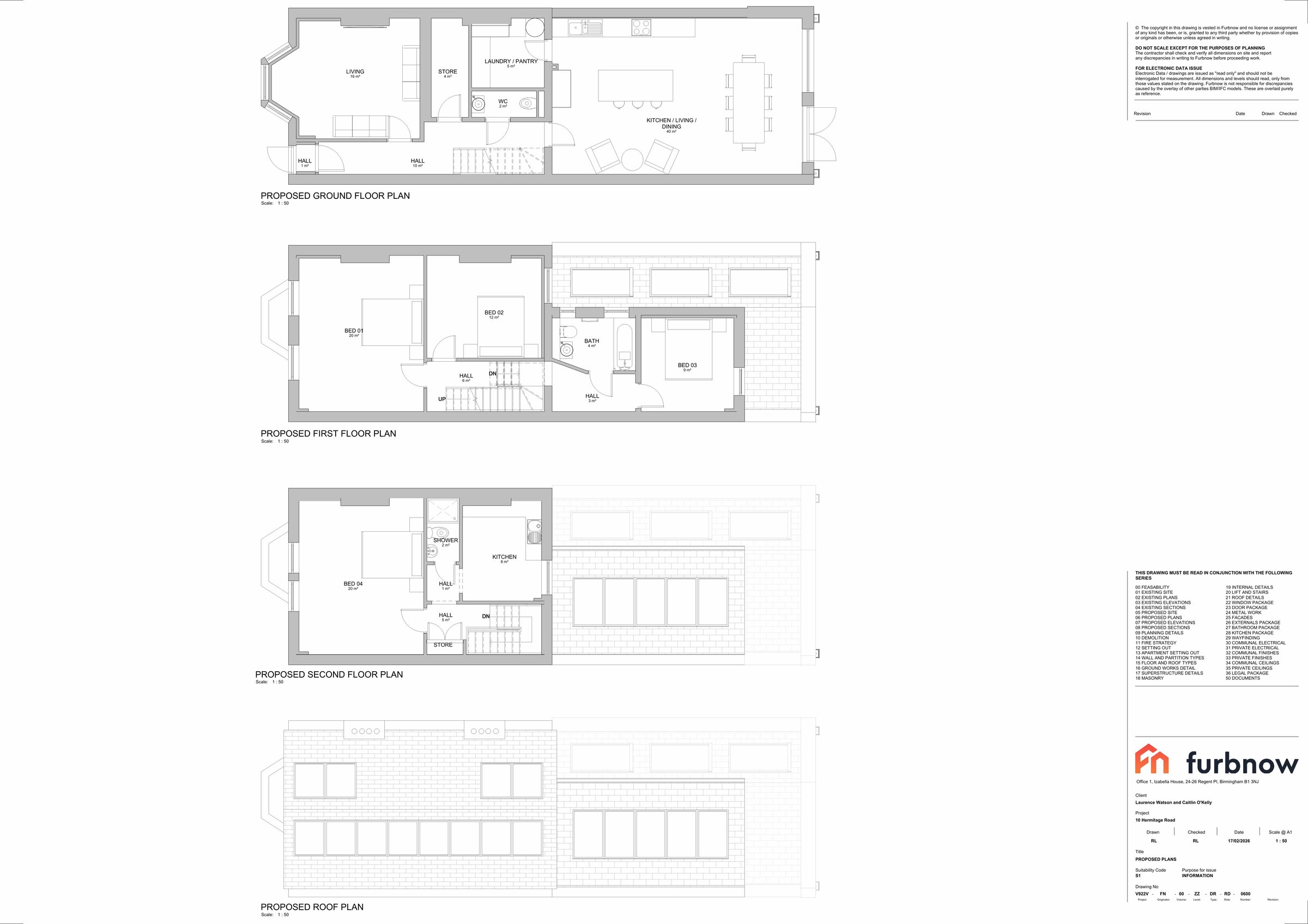
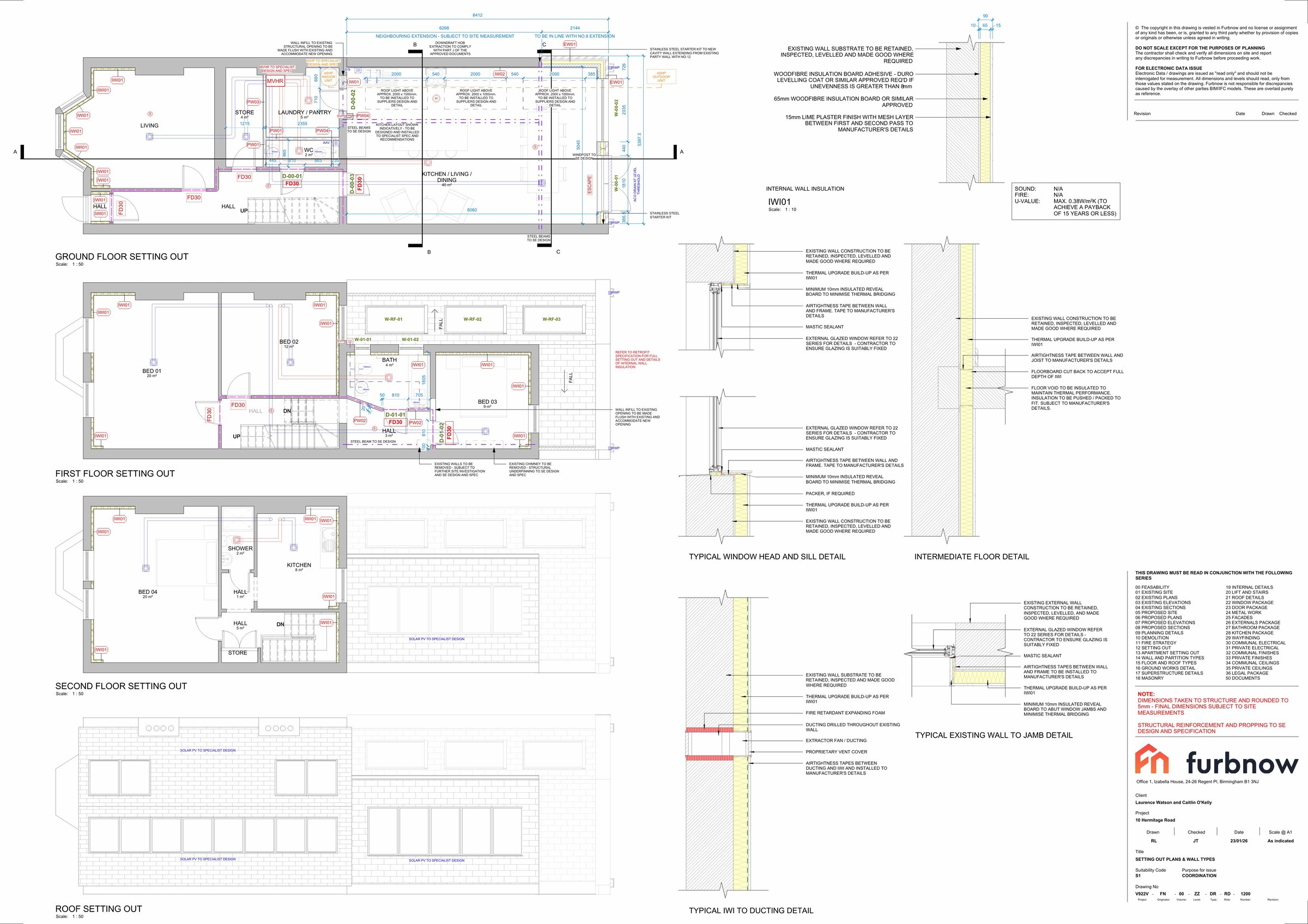
Survey floor plans
Your upgrades at a glance
| Measure | Area / size / quantity | Target start |
|---|---|---|
| Windows & Doors | — | — |
| Internal Wall Insulation | — | — |
| Loft Insulation Top-Up | — | — |
| MVHR — Mechanical Ventilation with Heat Recovery | — | — |
| Air Source Heat Pump | — | — |
| Solar PV & Battery | — | — |
Measures in detail
Each measure is specified on its own — dimensions, target performance, and what we will and will not accept.
Windows & Doors
Current situation
Suggested approach
What is included
- Full window replacement throughout
- Front and rear door replacement with insulated door sets
- All frames installed before IWI commences
Furbnow specification
- Minimum whole-window U-value of 1.4 W/m²K.
- Triple glazing recommended for north-facing elevations.
- All frames to achieve at least Window Energy Rating Band B.
- Product selection confirmed by the appointed installer to these performance standards.
What we are looking for
- Minimum U-value 1.4 W/m²K whole window, triple glazing on north elevations
- Frames installed before IWI so insulation dresses around the outer frame
Installer requirements
FENSA or CERTASS registered installer required for all glazing replacement. This is a legal requirement for replacing windows in England and Wales. The installer will issue a certificate of compliance on completion.
What to avoid
- Windows installed after IWI — this creates a cold bridge at the reveal
- Trickle vents specified as the primary ventilation strategy where MVHR is planned
Internal Wall Insulation
Current situation
Suggested approach
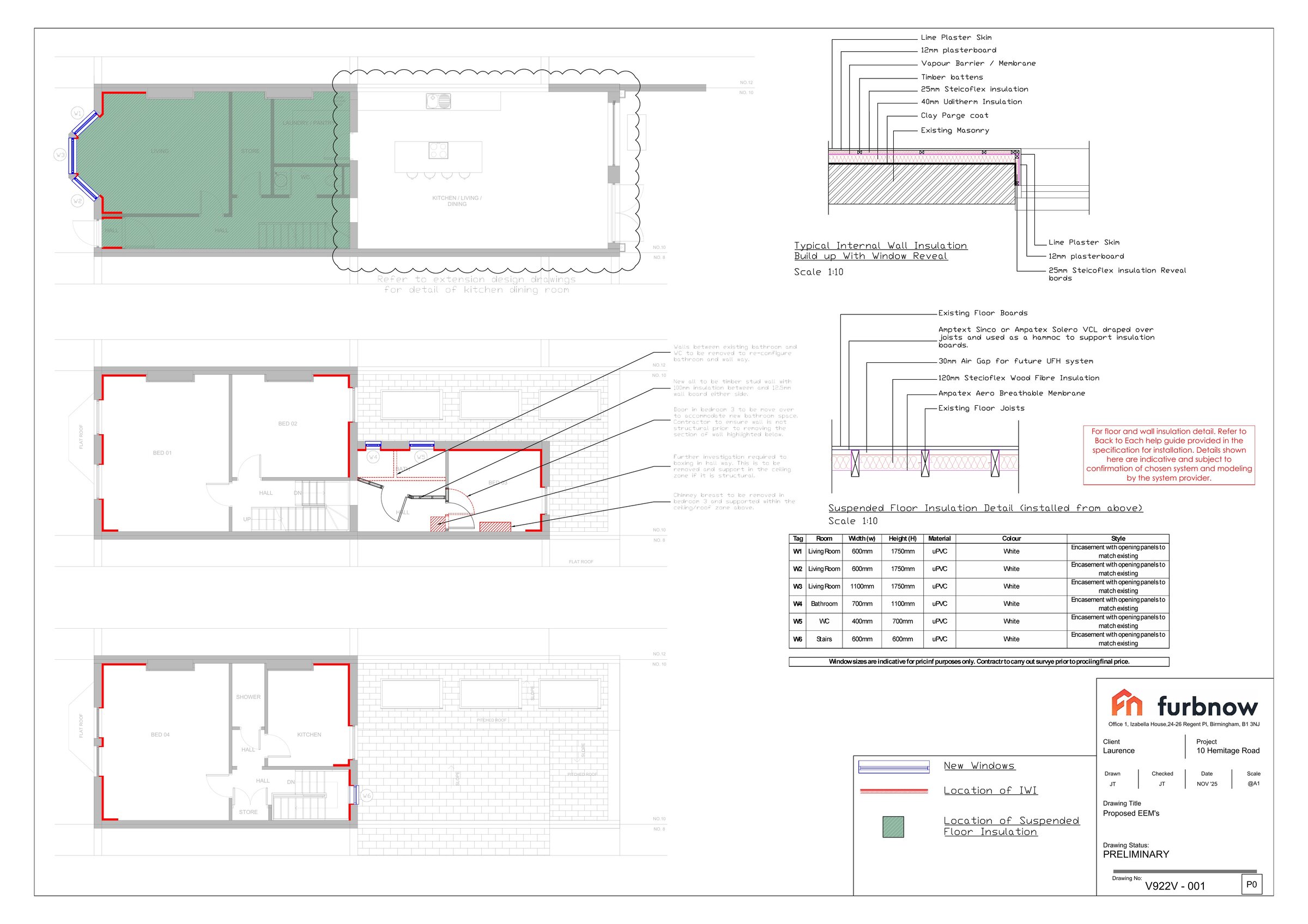
What is included
- Internal mineral wool insulation board, 120mm minimum
- Reinforced base coat and plaster finish
- All window reveals, sills, and eaves detailing
Furbnow specification
- Minimum U-value of 0.30 W/m²K post-installation.
- BBA-certified system required.
- All penetrations sealed to maintain airtightness.
- Junctions designed to avoid thermal bridging.
- We specify either the <strong>IWI Pro mineral wool system</strong> or the <strong>K Systems M mineral wool system</strong> (BBA-certified, A1-rated).
- System selection confirmed at specification stage.
What we are looking for
- BBA-certified mineral wool board system (IWI Pro or K Systems M)
- Continuous insulation at all junctions including around window openings
Installer requirements
Installer must hold relevant accreditation for internally insulated systems and carry appropriate liability insurance. System manufacturer approval and training certification required.
What to avoid
- EPS as the primary insulation layer where mineral wool is achievable
- Bridged or discontinuous insulation at eaves or window reveals
Loft Insulation Top-Up
Current situation
Suggested approach
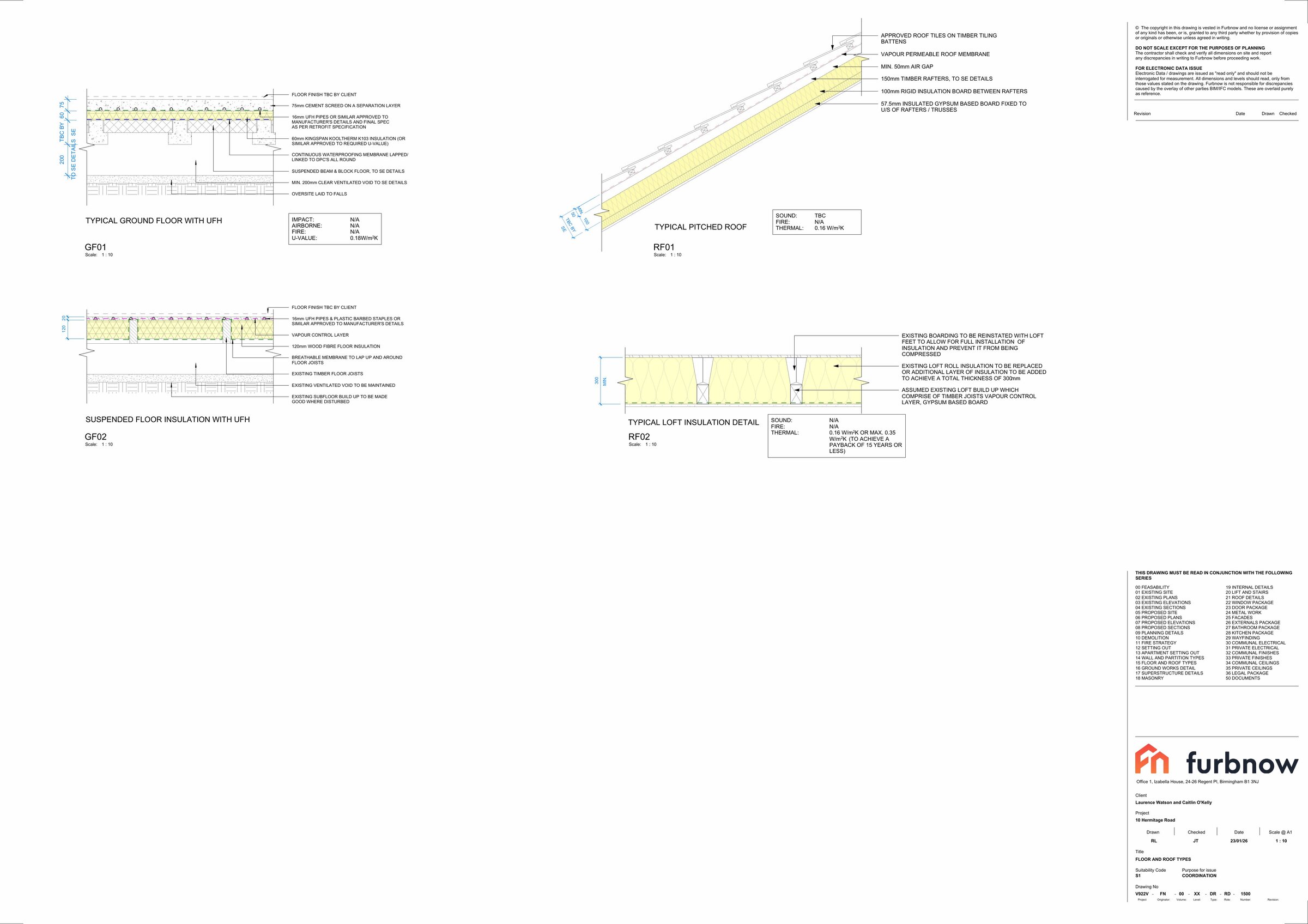
What is included
- Top-up from 100mm to 300mm total depth
- Eaves sealing to prevent cold air infiltration
- Tank and pipework lagging in the loft if present
Furbnow specification
- Minimum total depth of 300mm.
- We specify <strong>Knauf Earthwool Loft Roll 44</strong> (glass mineral wool, 0.044 W/mK, Euroclass A1, BS EN 13162).
- Second layer laid perpendicular to joists to eliminate thermal bridging.
- Eaves vents maintained where required for roof ventilation.
What we are looking for
- 300mm total depth, second layer perpendicular to joists
- Eaves sealed against cold air infiltration
Installer requirements
Installer must be registered with the relevant accreditation schemes. Our vetted specialist installers carry appropriate insurance and references for this type of work.
What to avoid
- Top-up layer running parallel to existing without a perpendicular cross-layer
- Blocking of roof ventilation vents
MVHR — Mechanical Ventilation with Heat Recovery
Current situation
Suggested approach
What is included
- MVHR unit, ductwork, and installation throughout
- Independent specialist design (duct layout, airflow calculations)
- Supply to all habitable rooms; extract from kitchen, bathrooms, and utility
Furbnow specification
- System designed by an independent MVHR specialist before the installer is appointed.
- Minimum 85% heat recovery efficiency.
- Units specified from <strong>Zehnder, Paul, or Brink</strong>; ductwork <strong>Lindab</strong>.
- Semi-rigid or rigid duct throughout; no flexible duct run longer than 1.5m.
What we are looking for
- Independent specialist design commissioned before installer tendering
- Units: Zehnder, Paul, or Brink; ductwork: Lindab
Installer requirements
BPEC-accredited installer required. The MVHR system design must be produced by an independent specialist before the installer is appointed. This is not the installer's responsibility to design.
What to avoid
- Installer designing their own system without independent review
- Flexible duct runs exceeding 1.5m
Air Source Heat Pump
Current situation
Suggested approach
What is included
- MCS heat-pump design package against post-retrofit heat load
- Monobloc outdoor unit, indoor hydraulic kit, and hot water cylinder sized to household demand
- Emitter survey and upgrade of undersized radiators for low-flow operation
- Commissioning, weather compensation setup, and BUS grant administration
Furbnow specification
- Monobloc system from <strong>Vaillant, Mitsubishi Ecodan, or Daikin Altherma</strong>.
- EN 14825 SCOP ≥ 3.5 at flow temperature 45°C against the post-retrofit design heat load.
- R290 refrigerant preferred where available.
- Cylinder minimum 180 L with ErP class B or better.
- Weather compensation enabled at commissioning.
What we are looking for
- Flow temperature ≤ 45°C at design outdoor temperature; emitters upsized where needed to achieve this
- Heat-loss recalculation against the post-IWI fabric, not the existing baseline
- Gas supply capped at meter once commissioning is complete
Installer requirements
MCS-certified heat pump installer required to release the Boiler Upgrade Scheme grant (currently £7,500 toward the install). The installer must produce a full MCS-compliant design package; this is not a quote-from-photos job. The Heat Loss Estimator Report is provided as background only — the formal MCS heat-loss calculation is part of the installer's design scope.
What to avoid
- Hybrid bivalent systems that retain the gas boiler as supplementary heat
- Sizing taken from a rule-of-thumb floor-area calculation rather than a full room-by-room MCS heat-loss survey
- Flow temperatures above 50°C at design outdoor temperature
Solar PV & Battery
Current situation
Suggested approach
What is included
- ~4 kWp panel array on south- and east-facing roof pitches per attached design
- SolarEdge inverter with per-module optimisers
- ~5 kWh AC-coupled battery storage, EV-ready
- DNO G98/G99 notification, MCS certificate, and SEG registration
Furbnow specification
- Modules: tier-1 monocrystalline, <strong>≥ 410 W per panel, 25-year product warranty</strong>.
- Inverter and optimisers: <strong>SolarEdge</strong> per the attached system design.
- Battery: minimum 10-year warranty, ≥ 6,000 full cycles.
- Roof fixings rated to local wind load; no fixings through any insulation layer added under the IWI or loft works.
What we are looking for
- Per-module optimisers (not a plain string inverter) to manage the morning shading on the east pitch
- Battery sized against the post-ASHP evening load, not generic household averages
- Installer handles all DNO and SEG paperwork end-to-end
Installer requirements
MCS-certified PV installer required for both the array and battery to qualify for 0% VAT and SEG export payments. The installer handles G98/G99 notification with the Distribution Network Operator before commissioning. Confirmation of available grid capacity is required given the ASHP load also added under the heat-pump measure.
What to avoid
- String inverters without per-panel optimisation, given partial shading on this roof
- Fixings penetrating IWI or new loft insulation without proper detailing
- Batteries with warranties under 10 years or below 6,000 cycles
Sequencing & timescales
These measures are sequenced to work together. Windows and doors are installed first so the IWI system can be dressed around the frames correctly, bringing them within the insulation layer. The loft top-up completes the envelope. MVHR follows once airtightness is confirmed. Heating is then switched from the gas combi to an air source heat pump, and a roof-mounted solar PV array with battery storage is installed last.
What to budget
VAT
BUS grant: The £7,500 Boiler Upgrade Scheme grant toward the ASHP is not netted off the figures above — the installer applies on your behalf and the grant is paid directly to them, reducing your bill at the point of install.
The difference this makes
Projections are based on current energy tariffs and SAP/RdSAP modelling. Actual savings depend on occupancy and how the heating is used.
Energy savings
- Heating & hot water (gas displaced)~£1,300
- PV self-consumption & SEG export~£600
- Solar generation~3,600 kWh/yr
- CO₂ reduction~4.3 tonnes/yr
EPC improvement
- Current EPCE (42)
- Projected EPCA (92)
A few things to verify
These items need further investigation before specifications and quotations are finalised. Tick each one off as it is resolved.
- 1External wall area — measured survey required
The IWI cost estimate is based on an approximate wall area. A surveyor will measure the property precisely before quotations are issued. Gables, bay windows, and any existing attached structures will affect the final area.
ActionFurbnow to arrange at survey - 2Planning permission — IWI on a semi-detached property
IWI on a semi-detached house in England does not typically require planning permission under permitted development, but the local authority should be consulted. Conservation area status and any Article 4 directions need to be confirmed for this address.
ActionFurbnow to check with North Yorkshire Council prior to specification - 3Current airtightness — baseline test recommended
No airtightness test result is available for this property. A baseline test before works begin is recommended to confirm the current infiltration rate and inform MVHR sizing. A re-test after windows and IWI are complete is required before MVHR is designed.
ActionFurbnow to arrange baseline blower door test - 4Loft access and obstructions
Access hatch size and any obstructions (tanks, pipework, stored items) need confirming at survey. If the hatch needs enlarging, this will be noted in the quotation.
ActionConfirmed at survey - 5Heat-loss recalculation against post-IWI fabric
The attached Heat Loss Estimator Report is a pre-retrofit baseline (external walls 1.64 W/m²K). The MCS heat pump design must be redone against the post-IWI U-values once the fabric specification is firm, so the ASHP is not oversized.
ActionMCS installer to produce design after IWI specification is signed off - 6DNO capacity for ASHP plus PV
Combined ASHP load and PV export need Distribution Network Operator confirmation. Notification under G98 or G99 (depending on system size) is handled by the PV installer, but capacity should be confirmed before formal quotations.
ActionPV installer to confirm with Northern Powergrid
Design files & technical documents
- Survey Floor PlanGround and first floor survey plans recorded on site.Download
- Annotated Survey Floor PlanSurvey plans with key dimensions, junctions and existing-build notes.Download
- Annotated Plan — Measure PositionsPlan showing where each proposed measure sits in the property.Download
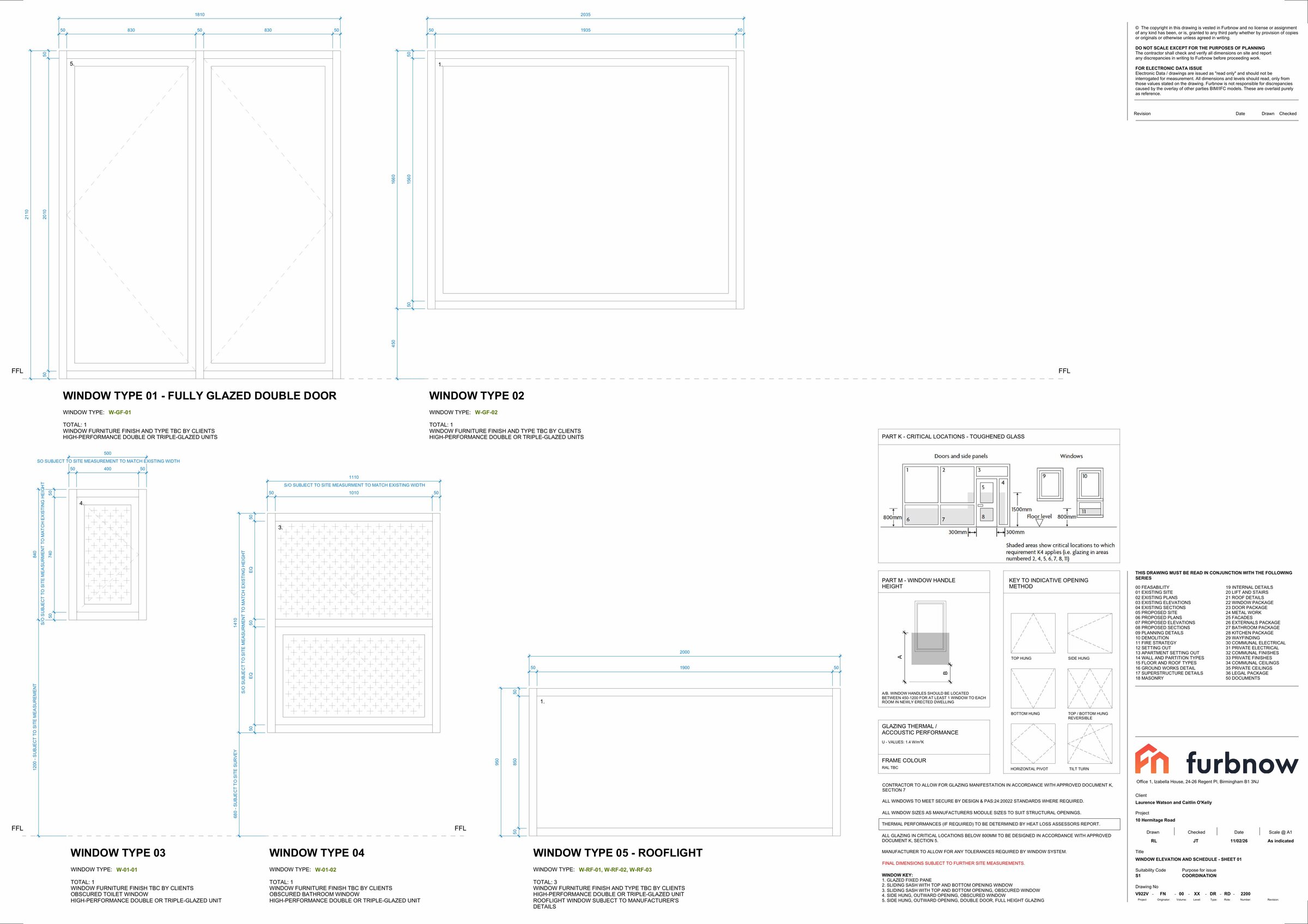
- Windows DetailElevations and schedule for replacement window units.Download
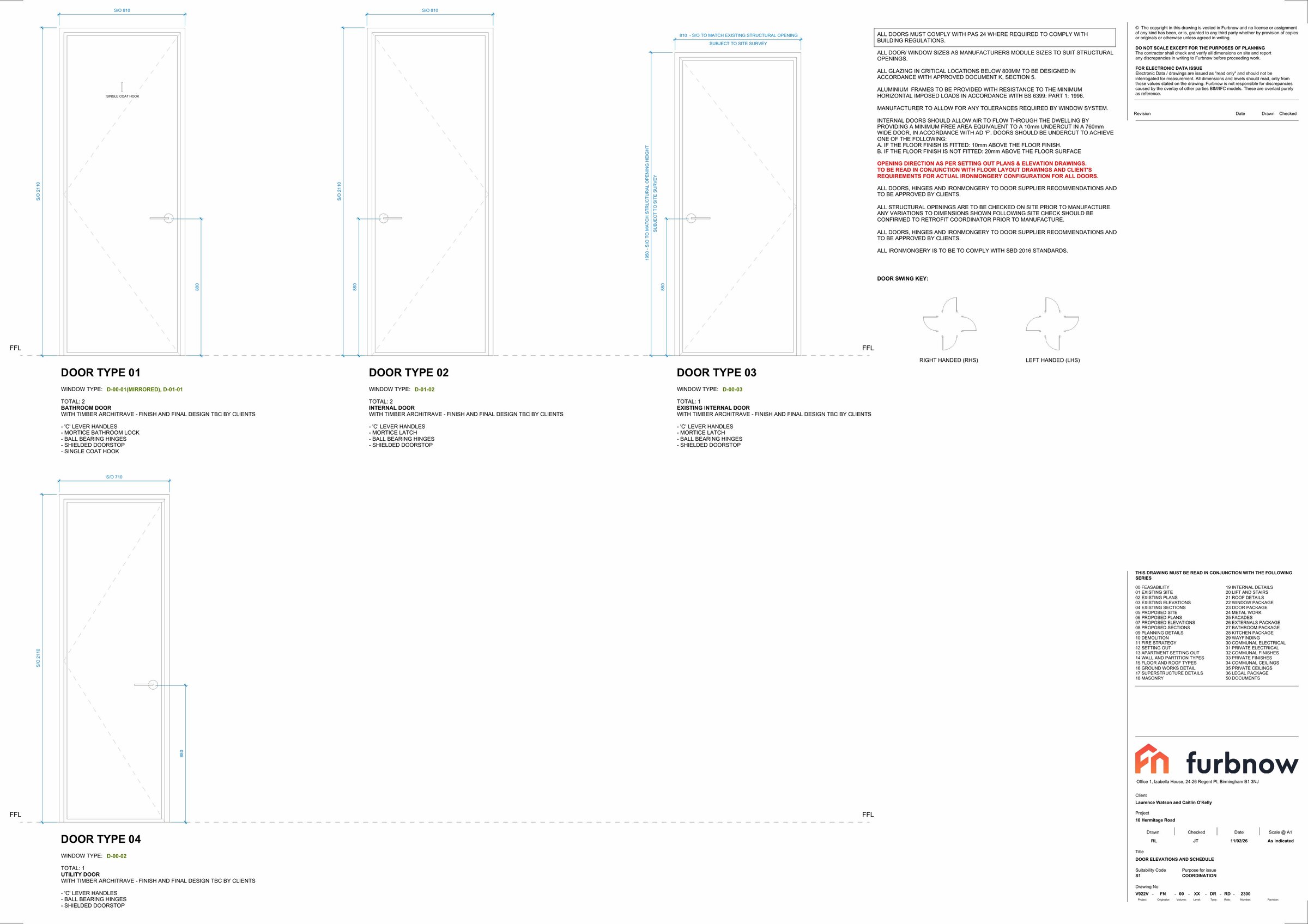
- Doors Elevations & ScheduleElevations and schedule for replacement door sets.Download
- Floor, Loft & Roof Insulation DetailBuild-up sections for floor, loft and roof insulation.Download
- Heat Loss Estimator ReportPre-retrofit baseline heat-loss report — input for the ASHP sizing exercise once IWI U-values are confirmed.Download
- Solar & Battery System DesignSolarEdge system design with proposed panel layout and string design.Download
- Air Permeability Test Certificate (baseline)Baseline Elmhurst airtightness certificate, 9.80 m³/(h·m²) @ 50Pa.Download
- MVHR Feasibility ConfirmationWritten confirmation from MVHR specialist — required before windows are ordered.Pending
- MVHR System DesignIndependent duct layout, airflow calculations and equipment schedule.Pending
- ASHP MCS Design PackageFull MCS heat-loss recalculation, system schematic and emitter schedule, produced once IWI U-values are confirmed.Pending
- Boiler Upgrade Scheme application£7,500 BUS grant application submitted by the MCS installer on your behalf.Pending
- DNO G98/G99 confirmationConfirmation from Northern Powergrid that the property has capacity for the proposed ASHP load and PV export.Pending
- Solar PV MCS & SEG certificatesMCS certificate, commissioning report, and SEG export registration for the PV array and battery.Pending
- Post-Installation EPCUpdated EPC to be lodged once all measures are complete.Pending
Ready to move forward?
Here is what to expect from here. No surprises, no pressure — you stay in control at every stage.
- Confirm and accept this Build Pack
- We arrange any initial surveys required
- We finalise quotations and designs with our system designers and contractors
- Some quotations require a site visit from our contractors — they will be in touch directly to arrange
- We present the final prices for your review
- Our vetted specialist installers carry out the works, following this Build Pack throughout
- Questions about any of the measures or the sequencing
- Want to prioritise one or two measures first
- Not sure about timing or budget
- Want to book a call with your Furbnow contact